What Customers Say About Caas vFFR
Dr. Joost Daemen, MD, PhD (Erasmus Medical Center, Rotterdam, The Netherlands)
" The results of FAST III[1] confirm the safety and feasibility of the online use of vFFR as an easy to use minimally invasive tool to guide revascularization in patients with intermediate coronary artery lesions in need of physiological lesion assessment. The use of vFFR eliminates the need for guiding catheters, invasive coronary artery instrumentation and hyperemic agents with inherent risks and patient discomfort."
Dr. Daniel Akrawi (Campbelltown Hospital, Western Sydney University, Australia)
" The VERMONT[2] study has completely reshaped how we think about physiology-guided PCI in routine practice. Real-time vFFR has proven to be far more than a convenient alternative; it delivers excellent diagnostic accuracy, high sensitivity, and a strong negative predictive value, even in complex, real-world patient populations.
vFFR seamlessly integrates into the cathlab workflow. The ability to compute physiology in real time, with a low exclusion rate and minimal image requirements, consistently saves us nearly 14 minutes per case compared with traditional wire-based assessment. In a busy lab, that efficiency matters.
Despite working with a higher-risk cohort—more diffuse disease, more calcification, more bifurcations - vFFR maintained robust rule-out performance. Its reliability allows us to safely defer nonsignificant lesions while reserving pressure-wire FFR for those cases where added confirmation is needed."
Dr. Krzysztof Milewski, MD, PhD (Cardiac Surgery Center in Bielsko-Biala, American Heart of Poland)

" The results of FAST III confirm that angio-based physiology such as vFFR, is non-inferior to wire-based FFR in guiding revascularization decisions. In today’s cathlab environment, where we face increasing complexity, time pressure, and a growing number of technologies, we need solutions that are not only accurate, but also simple, fast, and safe—and vFFR delivers on all of these.
It enables real-time physiological assessment without pressure wires or hyperemic agents, reducing procedural burden while allowing efficient evaluation of multiple vessels. This has the potential to shift coronary physiology from being underutilized to becoming a routine part of clinical decision-making.
In our experience, vFFR integrates seamlessly into workflow, saves meaningful time per case, and maintains reliable rule-out performance even in complex lesions, supporting confident deferral when appropriate."
[1] Joost Daemen et al. Angiography-Based Physiology to Guide Coronary Revascularization, New England Journal of Medicine. 2026 doi:10.1056/NEJMoa2601841
[2] D.Akrawi, K.Kadappu, J.Xu, et al., “VERMONT: Vessel Fractional Flow Reserve (vFFR) Assessment of Stenosis Severity: A Prospective Study,” Catheterization and Cardiovascular Interventions106 (2025): 3757-3765, https://doi.org/10.1002/ccd.70250
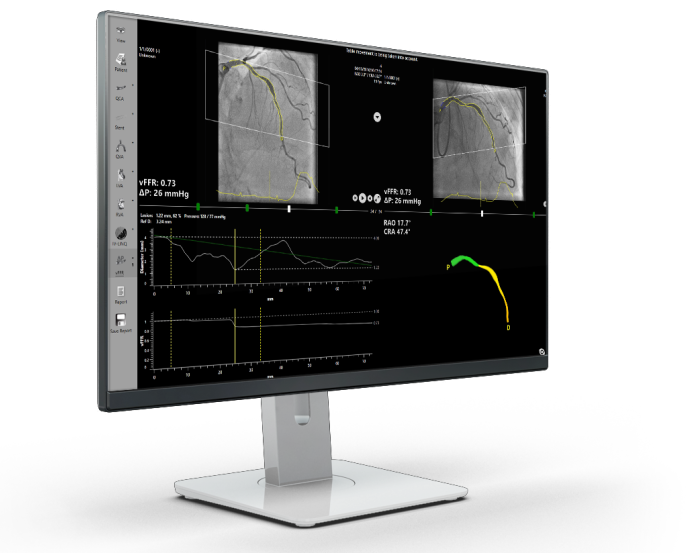
Caas vFFR
The vFFR workflow builds a 3D reconstruction of coronary artery and assesses pressure drop, resulting in a vFFR value. Furthermore, with the 3D reconstruction, anatomical lesion information is provided, like the percentage stenosis.
- Functional lesion information
- Anatomical lesion information